An internal Meta memo obtained by Business Insider this week describes an AI agent, code-named "Hatch," that can order food, DJ a playlist, and book you a table at a restaurant — all without you opening the app yourself. A product manager testing it said their agent, which they named Veda, had already found them a new dog sitter and bought a Father's Day gift. Meta is reportedly planning to launch Hatch inside WhatsApp and Instagram within weeks, and Morgan Stanley analysts now flag it as one of several products likely to ship now that Meta's youth-safety settlement has cleared a legal overhang on new launches.
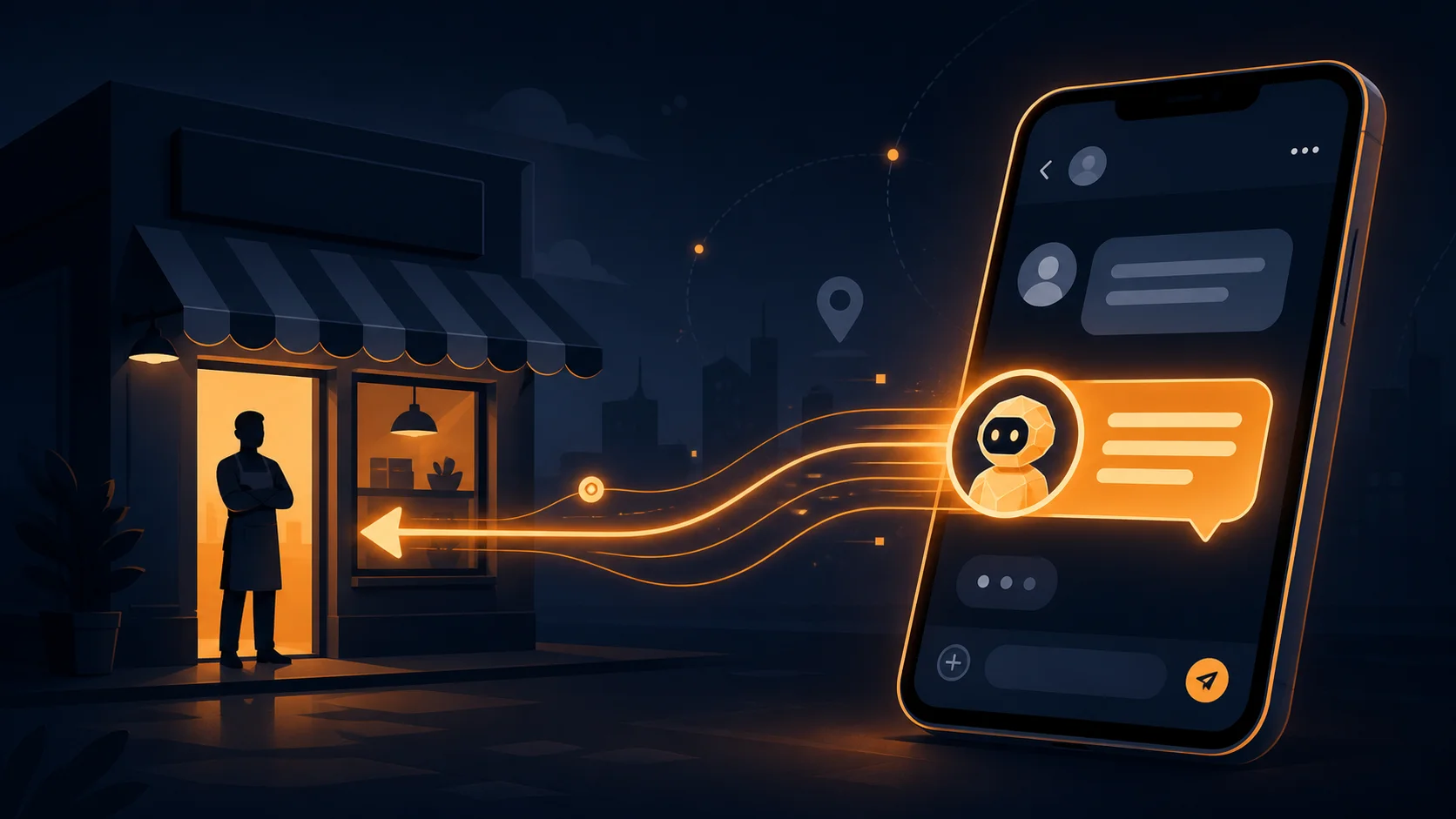
If you run a restaurant, a salon, a home services company, or any small business that takes bookings or sells through Instagram and WhatsApp, that memo describes something that will eventually happen to you: a customer's AI agent, not the customer, initiating contact with your business. The question worth asking this week isn't whether that's exciting or unsettling. It's whether your business is set up to be understood, and trusted, by something that isn't a person.
What Hatch Actually Is
According to the memo, Hatch is described internally as "a personal agent that's always working on your behalf to help achieve your goals and improve your life, your health, your relationships, your personal finances and more." Unlike a chatbot that answers questions when you ask, Meta says Hatch "has its own computer so it can do anything you can do online, like filling out forms, buying something, or performing deep research" — and it keeps working in the background even when the app is closed. The memo lists Spotify, Instagram, and OpenTable as example integrations, with users able to "approve any sensitive actions" before they happen.
Meta hasn't confirmed pricing or an exact launch date publicly, though The Information has reported a launch within weeks and pricing consideration as high as $200 a month. What matters for a small business owner isn't the exact date — it's the category. Hatch joins Google's Gemini Spark, OpenAI's computer-use agents, and a wave of similar consumer products racing to make "an AI that does things for you" the default way people interact with apps, including the ones your customers use to find and book you.
Why This Matters for Small Business
We've already written about the business side of this shift: Meta's own AI tools for small business now connect your Instagram, ad campaigns, and Google Workspace files into one assistant. Hatch is the mirror image of that release — instead of giving business owners an agent to run their operations, it gives consumers an agent to run their errands, and those errands increasingly include contacting your business.
This isn't an isolated Meta bet. We covered how Google's Universal Commerce Protocol, OpenAI and Stripe's Agentic Commerce Protocol, and Microsoft Copilot Checkout are already reshaping how AI agents discover and buy from small retailers. Hatch extends that same logic from e-commerce checkout into the messaging and booking channels — WhatsApp, Instagram DMs, OpenTable — that local service businesses depend on every single day. If your restaurant takes reservations through OpenTable or your salon takes bookings through an Instagram DM, you are already inside the exact surface Meta named as a Hatch integration target.
Not sure if your booking flow can handle an AI agent as the customer?
We help local and service businesses audit their WhatsApp, Instagram, and booking setups so a customer's AI agent gets accurate information — and a human still catches anything that needs judgment.
Book a Free Strategy Call →Where This Shows Up First
Three types of small businesses will feel this before anyone else, because they're exactly the use cases Meta's own memo describes:
- Restaurants and anything booked through OpenTable-style systems. "Book you a table at a restaurant" is the literal example Meta gave staff. If your reservation system has stale hours, unclear party-size limits, or no real-time availability, an agent making the booking on a customer's behalf has nothing accurate to work with — and it will either fail silently or book something wrong.
- Home services and appointment-based businesses. "Finding a dog sitter" was the product manager's own example. Salons, contractors, pet services, and anyone who takes appointments through Instagram or a booking link should expect agent-initiated inquiries to become a real channel, not a novelty, within the next year. This is the same readiness gap we found when auditing how a HVAC and plumbing company recovered missed-call revenue with AI — the businesses that win are the ones whose intake process doesn't depend on a human catching every inbound request in real time.
- Small retailers and gift-adjacent sellers. "Buying something," including the memo's own Father's Day gift example, puts small e-commerce and specialty retail squarely in scope. This compounds the structured-data readiness work we outlined for agentic commerce broadly — product data now needs to be legible to a consumer's personal agent, not just a shopping-specific bot.
What "Agent-Ready" Means Here
Keep your booking and hours data current and structured. An agent acting on a deadline — "get us a table by 7" — won't call to confirm your hours changed for a holiday. If your OpenTable, Instagram, or Google Business Profile listing is stale, the agent either books wrong or skips you for a competitor with accurate data.
Make your WhatsApp and Instagram Business presence a real channel, not an afterthought. If a customer's Hatch agent messages your business account with a booking request, whatever auto-reply or intake flow you have needs to actually capture the request correctly — name, party size, date, contact method — the first time, without a human needing to decode a garbled or overly terse agent-generated message.
Decide what still requires a human confirmation. Meta's memo says Hatch lets users "approve any sensitive actions" before they happen on the consumer side. Your business needs an equivalent policy on your side: which bookings, purchases, or requests get auto-confirmed, and which get a human look before anything is locked in. A same-day reservation for two is low risk. A large group booking or a high-value purchase initiated by an agent you can't directly question is not.
Watch for identity and no-show risk. A booking made by an agent on a customer's behalf is one more layer removed from a phone call with an actual human who has skin in the game. Track agent-originated bookings separately for the first few months so you can see whether no-show rates, order-accuracy issues, or fraud patterns differ from your normal channel mix before you decide how much to automate around them.
The Risk Nobody's Pricing In Yet
Meta's memo emphasizes that Hatch will "remember more than most AIs" and that users approve sensitive actions before they happen — reasonable-sounding guardrails from the consumer's side. But approval design on the customer's phone tells you nothing about what happens on your end when that approved action arrives at your business as a message, a reservation, or an order. If your intake process assumes every inbound request came from a person who can be called back for clarification, an agent-generated request that's slightly malformed or missing a field can silently create a bad booking, a wrong order, or a confused customer who never actually typed the message themselves.
This is the same governance gap we've flagged with every AI-agent-in-every-tool release this year: permissions and approval gates matter as much on the receiving end of an agent interaction as they do on the sending end. Our AI agent governance guide covers the approval-gate framework in more depth, and it applies just as directly to "a customer's agent is now messaging us" as it does to running your own AI tools internally.
2-Week Action Plan
You don't need a Hatch-specific integration to get ahead of this — you need your existing customer-facing channels to be accurate and well-structured before agent traffic becomes routine.
- Days 1–3: Audit your booking and hours data everywhere it's public. Check OpenTable, Google Business Profile, Instagram, and your own site for stale hours, outdated menus or service lists, and inconsistent contact information across platforms.
- Days 4–7: Test your own intake flow like an agent would use it. Send your business a terse, information-dense booking request through WhatsApp or Instagram DM — the way an agent would phrase it, not the way a person would. See what breaks.
- Days 8–10: Set your approval line. Write down, in one paragraph, which requests your team auto-confirms and which get a human look first. Share it with whoever answers your messages so it's applied consistently.
- Days 11–14: Add a tracking flag for anything that looks agent-originated. You won't always know for certain, but unusually formatted or oddly specific requests are worth tagging so you can watch for patterns over the next quarter.
Bottom Line
Hatch isn't live yet, and Meta hasn't confirmed final pricing or launch timing. But the direction is no longer speculative: Meta, Google, and OpenAI are each building a consumer agent whose entire job is to act on someone's behalf inside the exact apps small businesses use to take bookings, answer messages, and process orders. The businesses that handle this well won't be the ones who rush to build a Hatch integration on day one. They'll be the ones whose hours, availability, and booking data were already accurate and structured enough that any agent — Meta's, Google's, or the next one — gets the right answer the first time.
If you want help auditing your booking flow, WhatsApp and Instagram Business setup, and approval policies before agent-originated traffic becomes routine, book a free strategy call at apolloagent.ai. We'll help you find the gaps before a customer's AI agent finds them for you.