Somewhere this week, a customer told ChatGPT or Google's AI Mode what they wanted to buy, and an AI agent went and found it for them — comparing price, reviews, and delivery speed across merchants before a human ever looked at a product page. That is not a 2027 prediction. It is already the normal path to purchase for a growing share of shoppers, and most small business retailers have no idea whether they are showing up in that comparison at all.
Google launched its Universal Commerce Protocol (UCP) at NRF in January 2026, co-developed with Shopify, Etsy, Wayfair, Target, and Walmart, letting AI agents move through discovery, cart, checkout, payment, and post-purchase support using one open standard. OpenAI and Stripe announced the Agentic Commerce Protocol (ACP) in September 2025, launching Instant Checkout with U.S. Etsy sellers and planned support for more than a million Shopify merchants, including Glossier, SKIMS, Spanx, and Vuori. Microsoft Copilot Checkout and Perplexity's shopping features run on the same underlying idea: an AI agent, not a search results page, decides which products a shopper sees first.
What Changed: Shopping Became a Protocol, Not Just a Website
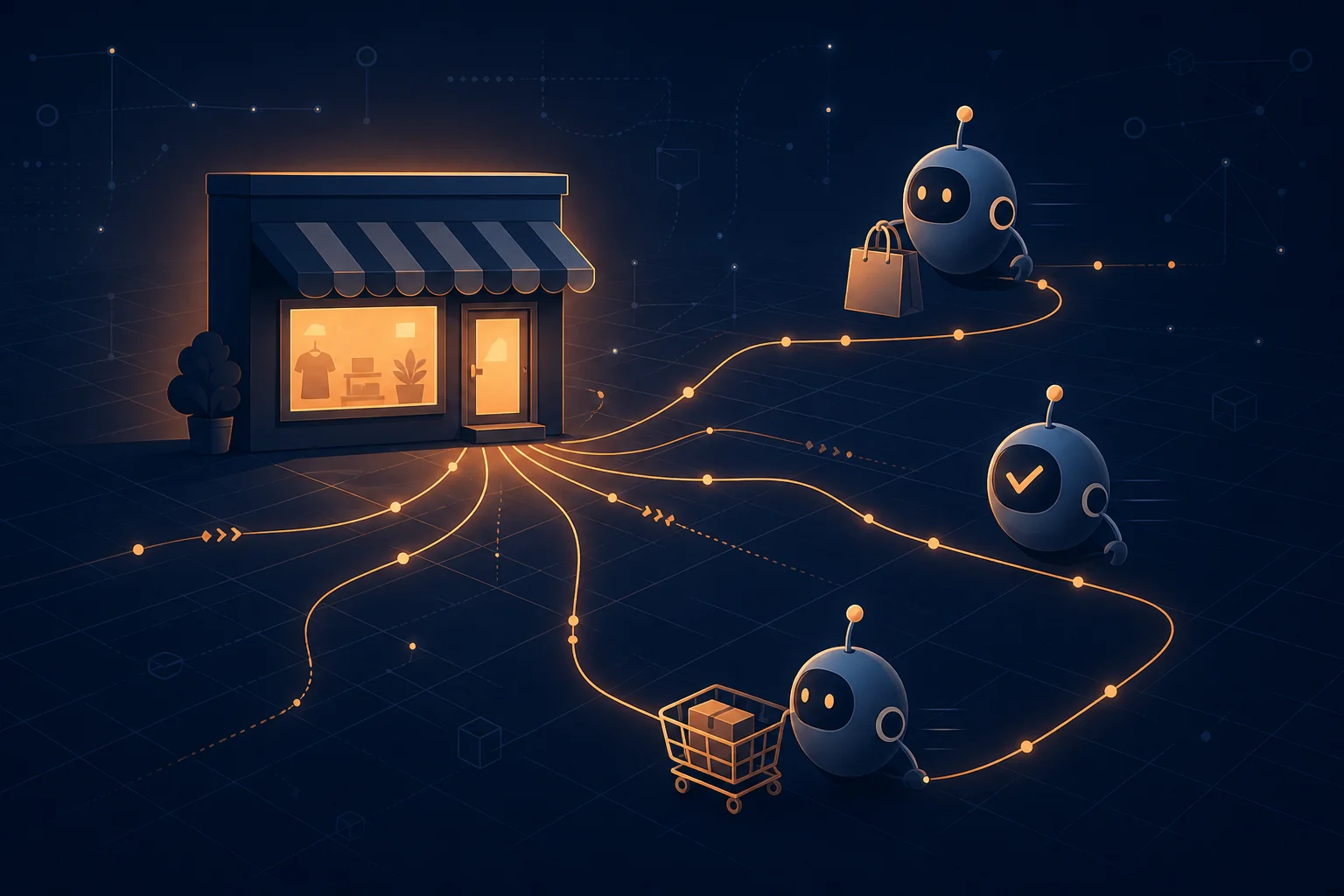
For most of the last decade, e-commerce SEO meant optimizing for how Google's crawler and a human's eyeballs interpreted a product page. Agentic commerce adds a third reader that behaves nothing like either one: an AI agent that queries structured data, evaluates attributes programmatically, and recommends a shortlist based on fit, not just keyword match.
The protocol landscape moved fast in the last year. Anthropic's Model Context Protocol (MCP), launched in late 2024, became a common data-connectivity layer for agents. Google's Agent2Agent (A2A) protocol lets agents coordinate with each other. ACP supports ChatGPT checkout flows, Stripe also powers Microsoft Copilot Checkout, and UCP is designed to cover the full journey from discovery to post-purchase. Google's Agent Payments Protocol (AP2) and payment programs from Visa and Mastercard now support scoped, verifiable agent-initiated payments, which makes autonomous purchasing on low-risk items technically possible instead of just theoretical.
One nuance worth knowing: reporting earlier this year indicated OpenAI pulled back from native in-chat checkout, while Shopify's current agentic commerce guide describes ChatGPT purchases completing through the merchant's online store in an in-app browser. If that pattern holds, it is good news for small retailers: AI agents become a discovery channel that still sends the customer, and the relationship, to you.
Why This Matters for Small Business Retailers
Adobe Analytics reported a 693% year-over-year increase in AI-driven retail traffic for the 2025 holiday season. Salesforce reported $67 billion in AI-influenced Cyber Week sales, with retailers using Agentforce 360 or branded agents growing sales 32% faster than those without. Shopify says Q1 2026 AI-driven traffic to Shopify stores grew 8x year over year, while orders from AI-powered searches increased nearly 13x. McKinsey has projected agentic commerce could redirect trillions of dollars in global retail spend by 2030. Even accounting for vendor enthusiasm, the direction is consistent: AI agents are becoming a real discovery and referral channel.
Here is the part that should worry a small e-commerce operator more than the hype: agents do not browse the way humans do. A shopper might click because the photo caught their eye. An AI agent evaluates structured product attributes — price, availability, size, material, shipping window, return policy — against the shopper's stated intent. If your product data is incomplete, inconsistent, or locked inside images and PDFs, the agent can skip you and recommend a competitor whose catalog is machine-readable.
This is the same dynamic we covered in our guide to AI search visibility for small businesses: showing up when customers ask AI a question requires making your content and data legible to a machine reader, not just persuasive to a human one. Agentic commerce is that same problem applied directly to your product catalog and checkout flow.
What "Agent-Ready" Actually Means
Structured product data. Every product needs machine-readable fields for price, availability, size or dimensions, material, color, shipping speed, and return terms — not just a description paragraph. If you run on Shopify, check whether your product feed populates these fields completely; default catalog eligibility does not mean your products appear for the searches you care about.
Accurate, real-time inventory and pricing. An agent that recommends a product only to find it out of stock or repriced at checkout creates a bad experience that platforms will eventually penalize. If your inventory sync has lag, that lag is now a visibility problem, not just an operations annoyance.
Honest, complete shipping and returns data. A generic "ships in 3–5 business days" message is invisible to an agent comparing delivery windows across merchants. Structured, accurate shipping data is becoming a ranking factor in agent-mediated comparisons the same way page speed became one for search.
A protocol strategy, not a single integration. ACP covers ChatGPT-style checkout flows. UCP covers Google's ecosystem and a growing list of retail and payment partners. If you sell through Shopify, you likely have a starting point, but "eligible" is not the same as "optimized." Treat your product feed like technical SEO: audit it periodically.
If your team already scaled with lean processes and AI tooling, this is a natural next step — our case study on how one e-commerce brand scaled to $5M with a 3-person team using AI shows what it looks like to treat AI infrastructure as a growth lever instead of an afterthought.
Not sure if AI shopping agents can even find your products?
We help small retailers audit their product data, close feed gaps, and get agent-ready without a full platform migration.
Book a Free Strategy Call →Risks and Guardrails
Agentic commerce introduces a new failure mode that most small retailers have never had to plan for: an autonomous system making a purchase decision, and in some cases completing a payment, without a human clicking "buy" on your side or theirs. Card networks including Visa and Mastercard now support scoped, verifiable agent-initiated payments through programs like AP2, which is a meaningful safety improvement over an agent simply holding stored credentials. But it also means the controls need to live on your end too.
Three guardrails matter most. First, price and availability integrity — make sure whatever an agent sees matches checkout, because a mismatch is a chargeback and trust problem. Second, order verification — treat unusual agent-referred orders like any other fraud-risk signal. Third, clear escalation paths — a customer who used an AI agent still needs a human to resolve problems. Our AI agent governance guide covers permission boundaries and approval gates for any AI system touching money or customer data.
A Practical 30-Day Action Plan
Don't try to chase every protocol at once. Start with an audit, then fix what's broken before adding anything new.
- Week one — audit your feed. Pull ten of your best-selling products and check whether price, availability, size, material, and shipping window are all in structured fields, not buried in a description. Note every gap.
- Week two — fix the highest-impact gaps. Prioritize your top 20% of SKUs by revenue. Complete missing attributes, correct stale inventory sync issues, and replace vague shipping copy with specific, accurate delivery windows.
- Week three — confirm visibility. If you're on Shopify, test whether your storefront appears in ChatGPT Shopping, Google AI Mode, and other relevant AI shopping results for your own product searches.
- Week four — set your guardrails. Define what happens when an AI-referred order looks unusual, who owns the escalation when a customer arrives from an agent conversation, and how you'll track AI-referred orders separately from other channels so you can measure whether this is actually working.
The Bottom Line
Agentic commerce is not a hypothetical future your business can wait to plan for. The protocols are live, the major platforms are shipping partner lists, and shoppers are already asking AI agents to find and compare products before they ever land on a website. The retailers who benefit will not be the ones with the flashiest product photography — they'll be the ones whose product data an AI agent can actually read, trust, and recommend with confidence.
The good news for small businesses: this is a data and process problem, not a budget problem. You don't need an enterprise commerce platform to be agent-ready. You need accurate, structured, current product information and a plan for what happens when an agent sends you a customer.
If you want help auditing your catalog and building a practical agentic-commerce readiness plan, book a free strategy call at apolloagent.ai. We'll show you exactly where AI shopping agents can and can't currently find your products, and what to fix first.