Walk into any tech conference right now, and you'll hear the same story repeated in different accents: an AI solution that's going to "transform" your business, "revolutionize" your operations, and deliver ROI "within weeks." The demos are slick. The results look incredible. The case studies are everywhere.
But here's the thing: the AI market in 2026 is flooded with vendors making claims that range from wildly optimistic to outright false. Some genuinely don't understand what their own tools can do. Others know exactly what they're doing and are counting on you to make a decision before you do your homework.
The result? Businesses are throwing money at AI solutions that deliver incrementally better versions of existing tools, while the real value sits waiting to be discovered in boring, unglamorous workflows. This guide gives you the playbook to tell the difference — the exact red flags to spot, the questions that cut through the noise, and a decision framework that actually protects you.
The Real Problem: "AI-Powered" Now Means Nothing
Let's start with the term itself. When a vendor tells you their product is "AI-powered," that statement is simultaneously true and meaningless. AI-powered can mean anything from "we're using a lookup table that vaguely resembles a trained model" to "we have a custom LLM fine-tuned on your specific data." Both are technically "AI." Neither tells you anything about whether it will actually work for your use case.
The market capitulation happened faster than you might think. By late 2025, every SaaS tool had slapped "AI" onto its feature list. Email clients got AI summaries. CRM platforms got AI lead scoring. Spreadsheet tools got AI suggestions. Some of it was genuinely useful. Some of it was $40 per seat per month for features that could run on a laptop from 2015.
What makes this worse is that many vendors genuinely believe their claims. They see a 73% accuracy improvement in lab tests (on cherry-picked data they control) and extrapolate that to "73% more customers" in your business (in the wild, with real data, in actual conditions). The gap between controlled benchmarks and production reality is where most AI investments go to die.
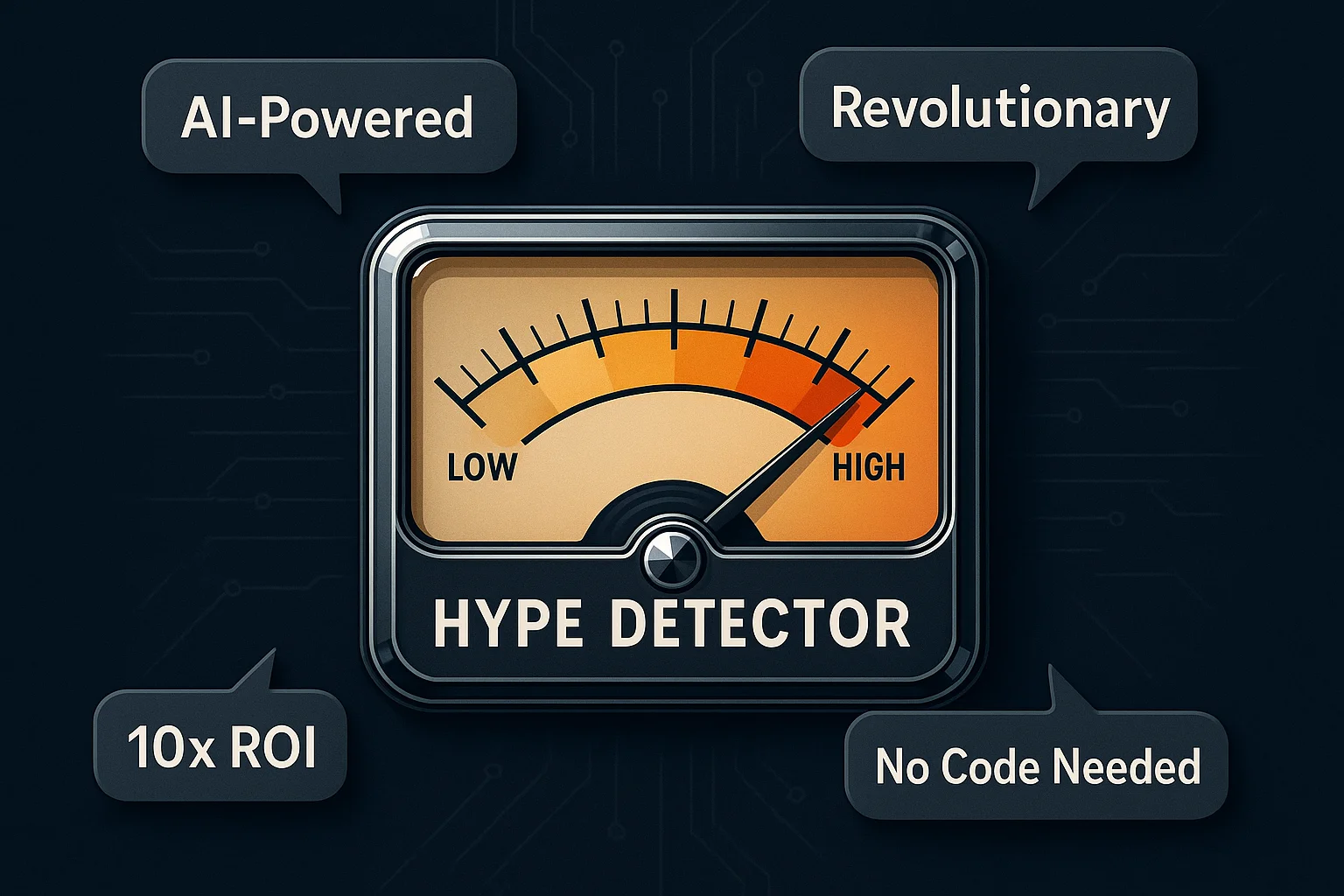
7 Red Flags That Signal an Overhyped AI Vendor
You've probably intuited some of these already. Let me name them explicitly so you can spot them in the next sales call:
1. "Our AI learns from your data to get better over time"
This is the vendor's way of saying they haven't actually solved your problem and they're counting on you to train their model for free. Legitimate AI systems are trained once, deployed, and monitored — they don't silently improve on production data. If they did, you'd have no way to audit whether they're actually getting better or just more confident in their wrong answers.
The exception: systems that explicitly allow you to label examples and retrain on them. But that requires your work, not passive "learning." Be skeptical of any vendor who claims their AI improves magically.
2. Accuracy claims without context
A vendor shows you 94% accuracy and stops talking. That number is worthless without knowing: What is it 94% accurate at? Was it tested on real data from your industry, or on their training set? What does the 6% error cost you? Is 94% accuracy meaningfully better than the 89% accuracy of the solution you're currently using?
Real vendors talk about accuracy in context: "We achieve 94% accuracy on customer inquiries in B2B SaaS settings, compared to 87% for manual triage by junior staff. That 7-point improvement translates to 20 fewer escalations per 1,000 tickets monthly."
3. "Best-in-class" or "industry-leading" without evidence
These are marketing filler. They don't mean anything because there's no third-party authority on "best in class" for most AI tools. If a vendor can't point to a specific benchmark, a specific competitor comparison, or a specific independent study, they're just winging it.
4. No data about failure modes
Every AI system fails sometimes. The question is whether the vendor understands how and when. If a vendor tells you their AI will "handle 95% of cases automatically," they should immediately explain what the other 5% looks like. Are those the weird edge cases? The high-stakes decisions? The ones that cost you the most money?
Vendors who don't proactively discuss failure modes haven't thought about them, which means you'll discover them the hard way — in production, at scale, on your dollar.
5. Long sales cycles for simple problems
If a vendor needs 90 days of discovery, custom configuration, and implementation for something that should take two weeks, you're not buying AI — you're buying consulting disguised as software. Real AI tools come with working assumptions built in. You might customize them, but you shouldn't need six months of onboarding before you see the first result.
6. "We can't show you real customer data" — even anonymized
Legitimate AI deployments generate measurable results that vendors can share (with privacy protections applied). If a vendor can't show you anything except generic before-and-after metrics, it's because they don't have case studies where the results held up in the real world. They have pilots that looked great and then stalled.
7. "It's magic" or "it's proprietary"
You don't need to understand how transformers work to buy an AI system. But you should understand what it does and how it makes decisions. If a vendor deflects every technical question with "it's too complex to explain," they're either incompetent or hiding something. Neither is good for you.
Too much noise? Get clarity on what AI can actually do for you.
We evaluate AI vendors for clients every week. Book a free strategy call and we'll help you separate signal from hype — no sales pitch, just straightforward advice.
Book a Free Strategy Call →The Proof-of-Concept Framework That Actually Works
So you've filtered out the worst offenders and found a vendor who seems credible. How do you actually test whether their AI will work for your business?
Don't do a 90-day pilot. Do a two-week proof of concept instead, and make it ruthless.
Week 1: Define Success Metrics Before Testing
Decide upfront what "success" looks like. Not "the AI seems pretty good." Real metrics: accuracy rate, time saved per transaction, error rate, adoption rate among your team, cost per outcome. Write these down. Share them with the vendor. Agree on the success criteria before you test anything. This prevents the vendor from moving the goalposts later ("well, we weren't optimizing for that metric").
Week 2: Run on Your Actual Data
Not their data. Not anonymized test data. Your data, your real edge cases, your actual volume. The vendor should be willing to do this. If they push back ("we need to clean the data first" or "your data structure is too complex"), that's a red flag. Good AI systems are built to handle real-world data.
Run the PoC in parallel with your existing process. Don't replace your current workflow. Just run the AI system alongside it and compare outcomes. When you find mismatches, document them.
The Decision
After two weeks, you should be able to answer three questions: Did it meet the metrics we defined? Did it break in ways we didn't anticipate? Would our team actually use it? If the answer to all three is yes, move forward. If it's no to any of them, either negotiate fixes or walk away.
5 Questions That Cut Through the Noise
In your next conversation with a vendor, ask these questions. Pay close attention to how they answer — not just the content, but the confidence level, the specificity, and whether they acknowledge the limits of what they're claiming.
1. "Show me the specific workflow this replaces or enhances. What happens in the 10% of cases where your AI doesn't work?"
This separates vendors who understand their own product from vendors who've memorized a pitch. They should walk you through a real scenario from your industry — step by step, with specifics about where AI adds value and where it hands off to a human. If they can't do this, they haven't actually thought through implementation.
2. "How does your solution compare to implementing an open-source LLM like Llama or Mistral with a wrapper we build ourselves?"
This question tells you whether the vendor has a real defensible advantage or whether they're just a prettier interface around commodity technology. If their answer is "you couldn't possibly build this in-house" but also "we built it as a small team in 12 months," you've caught an inconsistency. The truth is usually somewhere in the middle: you could build it yourself, but the vendor has invested time you haven't, and that differential is worth paying for. A vendor who owns that is honest. A vendor who claims it's impossible is either incompetent or lying.
3. "What do you measure in your own operations to track whether this is actually working for customers?"
This separates vendors who care about real outcomes from vendors who care about getting your signature. Do they track adoption rates? Customer churn? Support tickets? ROI attainment? If they don't, it's because they don't know whether their own product is working.
4. "If this doesn't work for us in 30 days, what's the exit cost?"
Watch for hesitation here. Watch for lawyers getting involved. Watch for "well, it depends." A vendor confident in their product should be willing to offer a straightforward refund or termination clause. If they can't, either the product doesn't work often enough to make that promise or they're not confident enough in their outcome. Both are signals to walk.
5. "How often have you implemented this in companies exactly like ours, and what was the actual outcome?"
Not "we've worked with companies in your space." Specific. Names. Case study. The vendor should have at least three reference customers they can point to — ideally customers you can actually call. If they don't, they don't have proof the product works at scale, and you'd be the experiment.
The AI Buying Checklist
Use this before you sign anything:
- Vendor can articulate failure modes clearly. They know what doesn't work and why.
- Success metrics are defined before testing. You're not evaluating based on whatever the vendor says works.
- Two-week PoC on your real data is possible. Not a 90-day discovery project.
- Real reference customers in your space exist. You can call them and get honest answers.
- No "learning from your data" claims. The model is frozen, not silently self-improving on your dime.
- Accuracy numbers come with context. You know what they're accurate at, against what baseline.
- Exit terms are clear. You're not signing a five-year contract you can't escape if it doesn't work.
- The vendor can explain the alternative. Why is their AI better than building it yourself or using a different approach?
- Human oversight is built into the workflow. AI doesn't run completely unsupervised on decisions that matter.
- You've actually talked to the people who built it. Not just the sales rep. The engineers. The product team. People who understand the constraints.
Check all ten boxes and you're probably looking at a real product from a real vendor. Check fewer than six and you're probably looking at a well-marketed mediocrity.
The Bottom Line
AI is real. It delivers real value. But the gap between real and overhyped has never been wider. Your job as a business owner is to get to the real part without spending six months and $200K on the overhype.
The tools are simple: ask questions, demand specificity, run narrow PoCs, talk to reference customers, and walk away from vendors who can't answer you clearly. The vendors worth buying from won't mind the scrutiny — they'll welcome it. The ones who get defensive or evasive? Those are the ones to avoid.
Ready to evaluate AI for your business with confidence? Check out our guide to streamlining workflows with AI, or read our complete guide to AI agents for business leaders. If you need help vetting vendors or evaluating whether AI makes sense for a specific process, book a free 30-minute strategy call with our team — no sales pitch, just straightforward advice on what's real and what's theater.